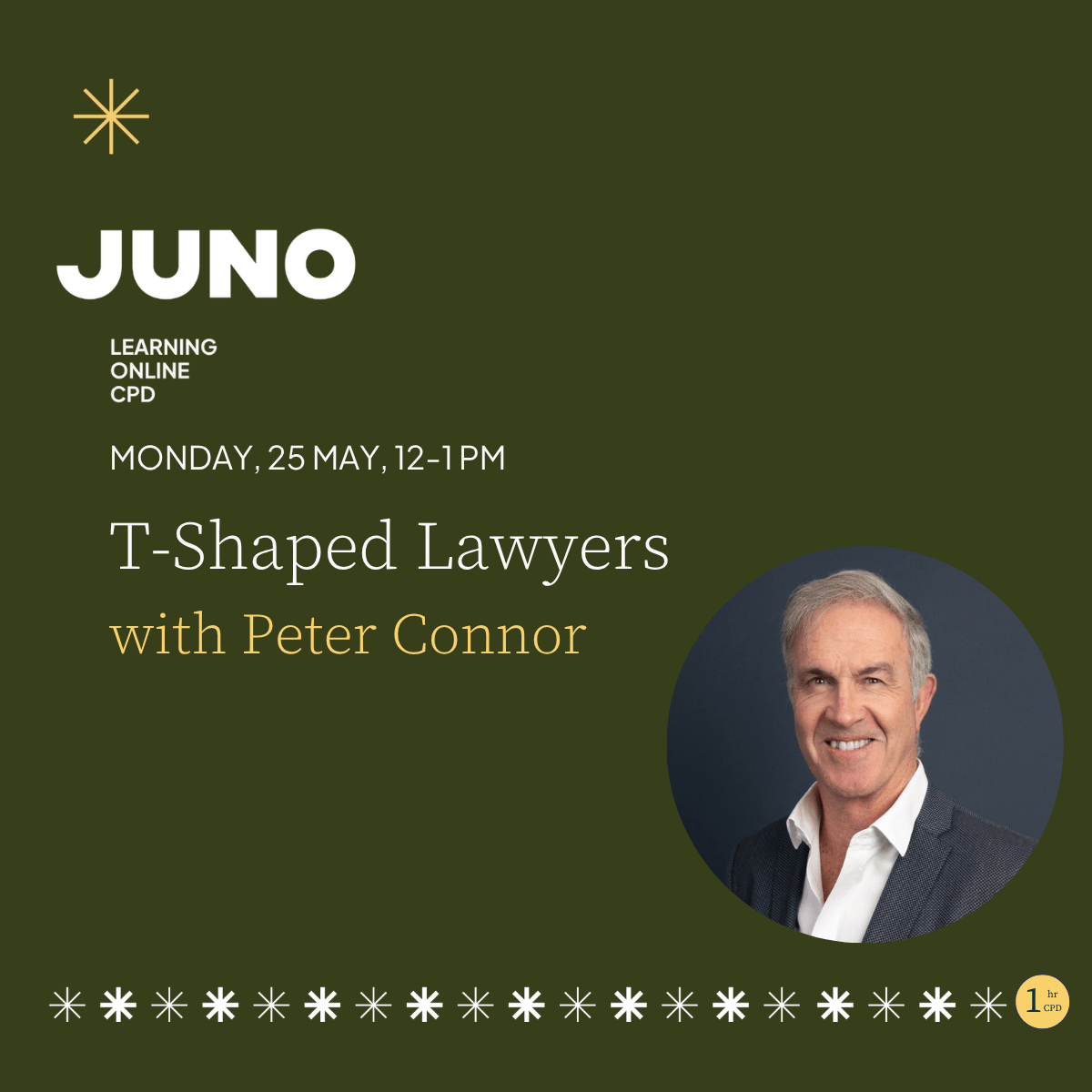
Recently, Peter Connor, Legal Team Coach and the author of The Online T-Shaped Legal programme, joined our Juno Learning community to explore what it means to be a T-shaped lawyer: combining deep legal expertise with the broader capabilities, business understanding and curiosity needed to contribute beyond purely legal advice.
Hundreds of in-house lawyers from across Aotearoa and beyond joined us for a thought-provoking and refreshingly frank conversation about the changing shape of in-house legal work.
Ngā mihi nui to Peter for sharing his framework and experience with our community.
Missed the session or want to revisit it? Watch the recording
One thing we’ve consistently heard through our Juno Learning series, and something we care strongly about too, is giving people practical ideas they can genuinely apply in their day-to-day work. We’ve created Turning the T-shape into practice, a short companion activity with practical scenarios and reflection prompts based on ideas from the session. Try the Juno Turning the T-shape into practice companion activity
How much of your work is actually legal work?
One of Peter’s provocations was to ask in-house lawyers to look closely at how their time is actually spent.
His experience analysing legal teams around the world suggests that what he calls “true legal work”, work that genuinely requires legal expertise, can account for only around 15–20% of an in-house lawyer’s time.
The rest might include internal business work that helps the legal function operate, administrative
“True legal work often makes up only around 15–20% of an in-house lawyer’s time.” | ||||
That doesn’t mean non-legal work is a problem. In fact, contributing to the wider business is a big part of being T-shaped.
The more useful question might be: what kind of work are you spending your time on, and is it where you can add the most value?
Try looking back over a few recent days and roughly categorising your time. What required your legal expertise? What helped the wider business? What was administration or overhead?
And perhaps most importantly: what could you do less of to create room for more valuable work?
Get your head above the day-to-day
Peter’s advice for becoming more T-shaped was deceptively simple: get your head above the day-to-day. In-house lawyers are often working across many different parts of an organisation. That puts them in a particularly useful position to see patterns, make connections and spot issues that might otherwise fall between the cracks. The opportunity lies in looking beyond the immediate legal question.
Why does this issue keep coming up? What is happening in the business underneath it? Is there a process that isn’t working? A risk nobody quite owns? An opportunity to do something differently?
That doesn’t mean taking over someone else’s role. Peter used the example of being asked to review marketing material. Spotting every grammatical error and rewriting the copy may not be the best use of a lawyer’s time simply because they are capable of doing it.
Business partnering is about knowing where your contribution will genuinely add value, and where it won’t. Sometimes the starting point is simply noticing what’s going on around you and asking another question.
Use what you already have
The horizontal part of Peter’s T-shaped framework encompasses five areas: mindsets, qualities, competencies, skills and knowledge.
That can sound like a substantial list of things to develop. But becoming more T-shaped doesn’t necessarily mean starting from scratch. Lawyers already bring many capabilities that are valuable well beyond giving legal advice. Critical thinking. Curiosity. Problem solving. Communication. Risk assessment. Adaptability. The ability to ask good questions, get to the root of an issue and think through the consequences of different decisions.
Peter’s challenge was to use those capabilities more broadly.
- Instead of applying your questioning skills only to the legal issue, what happens when you turn them towards the business problem underneath it?
- Instead of only identifying legal risk, where could your ability to analyse risk help the organisation make a better decision?
- And rather than beginning with everything you think you need to learn, it may be worth first noticing the strengths you already have and where else you could put them to work.
Turning the T-shape into practice
The T-shaped framework is broad, but putting it into practice doesn’t need to mean changing everything at once.
A useful starting point might simply be to notice where your time goes, lift your eyes from the legal question in front of you, and stay curious about what else is happening around it.
We’ve created Turning the T-shape into practice to help you take that next step. It includes practical scenarios and reflection prompts covering business partnering, categorising your work, identifying your existing strengths and finding opportunities to add value beyond legal advice.
Try the Juno Turning the T-shape into practice companion activity
You can also catch up on Peter’s full session in our Juno Learning video resources. Watch the recording
More from Juno Learning
Juno Learning brings the in-house legal community together to learn from people with useful ideas, experience and perspectives to share.
Our sessions are designed with the realities of in-house legal work in mind, focusing on useful knowledge, practical application, and generous sharing across the community.
Explore Juno Learning and our video resources
Want to join us next time? Subscribe to Juno Learning to receive invitations to upcoming sessions.